This is life insurance advertising and is for general informational and educational purposes only. It is not financial, tax, legal, or investment advice. Life insurance policies contain fees, expenses, limitations, and exclusions, and policy features and availability vary by carrier and state.
Life insurance is primarily designed to provide a death benefit. While permanent life insurance policies may accumulate cash value, they are not intended to replace traditional investment accounts. Cash value growth is not guaranteed and depends on policy terms, charges, insurer crediting practices, and, where applicable, investment performance.
Accessing cash value through loans or withdrawals will reduce policy values and death benefits and may increase the risk of lapse. Policy loans accrue interest. If a policy lapses or is surrendered with an outstanding loan balance, taxable income may result. Policies classified as modified endowment contracts (MECs) are subject to different tax treatment, including potential taxes and penalties on distributions.
Indexed universal life insurance (IUL) credits interest based on index performance, subject to caps, participation rates, spreads, and insurer crediting methods. While index-linked strategies typically include a minimum crediting rate, policy values can decline due to charges, loan activity, or insufficient premiums.
Key Takeaways
- A personal health scare is the #1 motivator for buying life insurance.
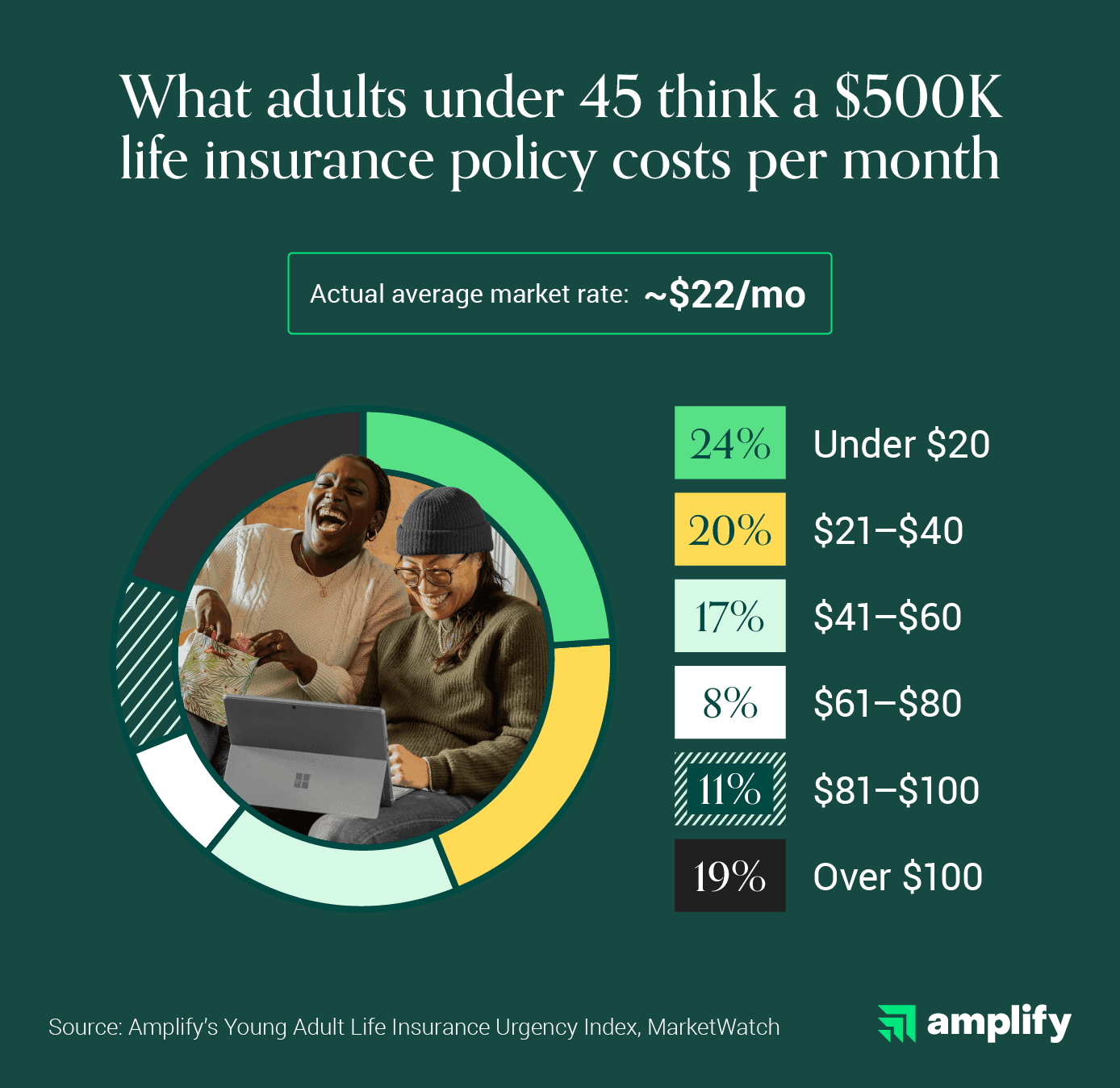
- 56% of adults under 45 think a $500,000 policy costs more than $40 per month, more than double the average real-world rate for a healthy 30-year-old.
- Parents of children under 18 feel more urgency about purchasing life insurance than non-parents (53% vs. 39%), yet the vast majority still have no coverage.
- 20% of respondents believe nothing could motivate them to research or buy life insurance in the next 12 months.
Most people assume they'll get around to buying life insurance at some logical life event. Maybe after the wedding. After the baby. After the mortgage. The plan is to get to it eventually, and "eventually" keeps moving.
Amplify surveyed more than 1,000 U.S. adults ages 18 to 45 and found that 86% of them don't currently have life insurance. And when we asked what would finally move them to get covered, the #1 answer wasn't a wedding, a child, or a new home. It was a personal health scare (28%), which was ahead of every planned milestone on the list.
For most young adults, life insurance is a reactive purchase, not a planned one. And while they're waiting, most have no idea what they're missing.
For most adults under 45, buying life insurance takes a scare
Most adults under 45 know they need life insurance. They just don't feel the urgency to do anything about it yet. 42% of respondents said they feel they should already have life insurance or will need it sooner than they thought. Only 10% called it a top financial priority. 47% ranked it as a low or non-priority.
What would finally create that urgency? Not a planned milestone. When asked what would trigger it, a personal health scare ranked first (28%), followed closely by a health scare affecting a loved one (22%). No planned life event came close. For most adults under 45, it doesn't happen at a milestone. It happens at a moment of fear.
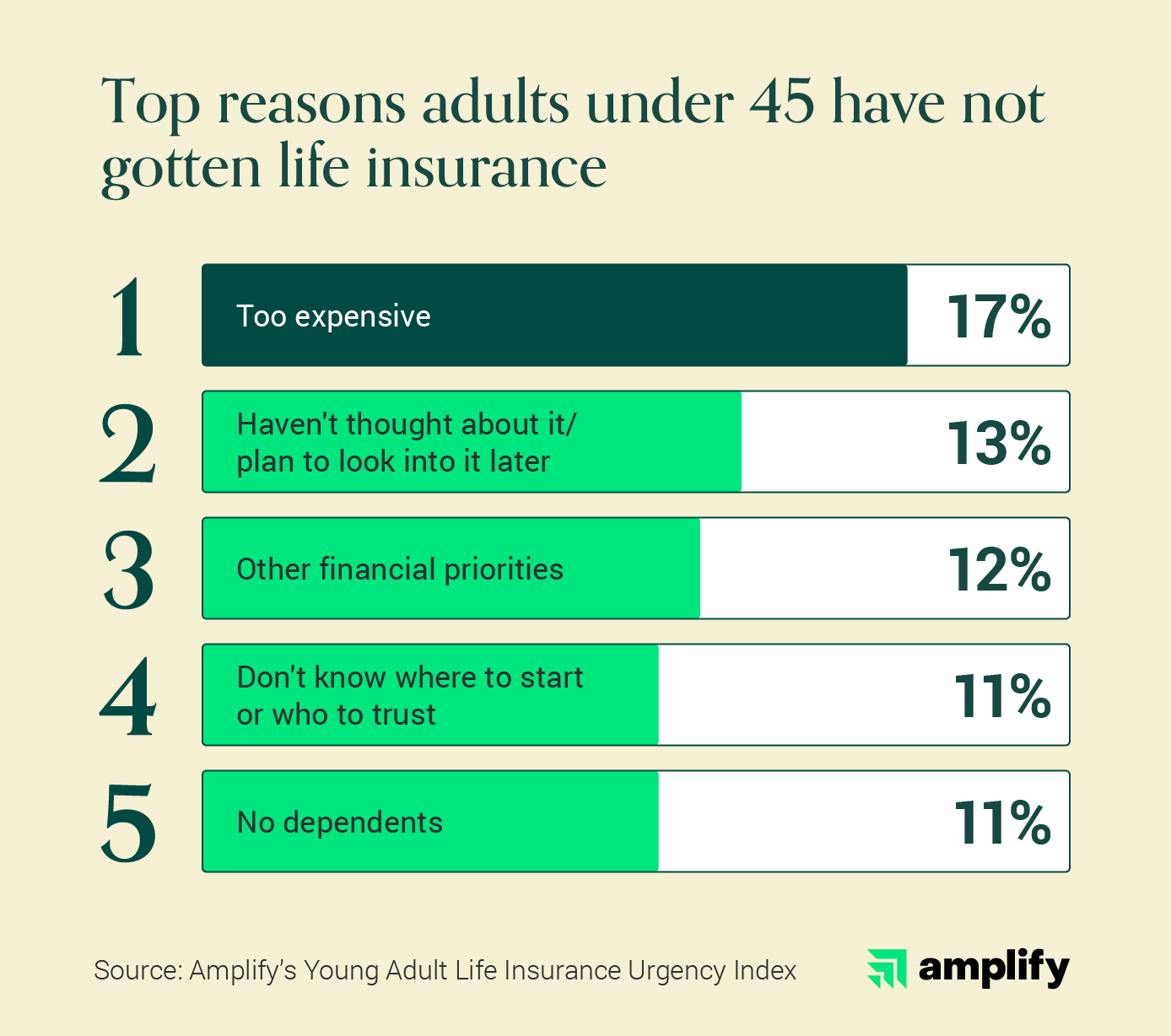
The reasons people give for not acting yet reinforce this pattern. Cost leads at 17%, followed by 13% who say they haven't thought about it or plan to look into it later, other financial priorities (12%), and not knowing where to start (11%). None of these are hard objections. They're soft deferrals.
But the data also suggests the push doesn't have to come from a crisis. 18% said finding an affordable, easy-to-understand online option would motivate them to act in the next 12 months. For a meaningful share of this audience, access and simplicity may be enough.
Marriage, kids, and a mortgage are not what actually move people to buy
There's a version of the life insurance timeline most people learned somewhere. Get married, get covered. Have a kid, get covered. Buy a house, get covered.
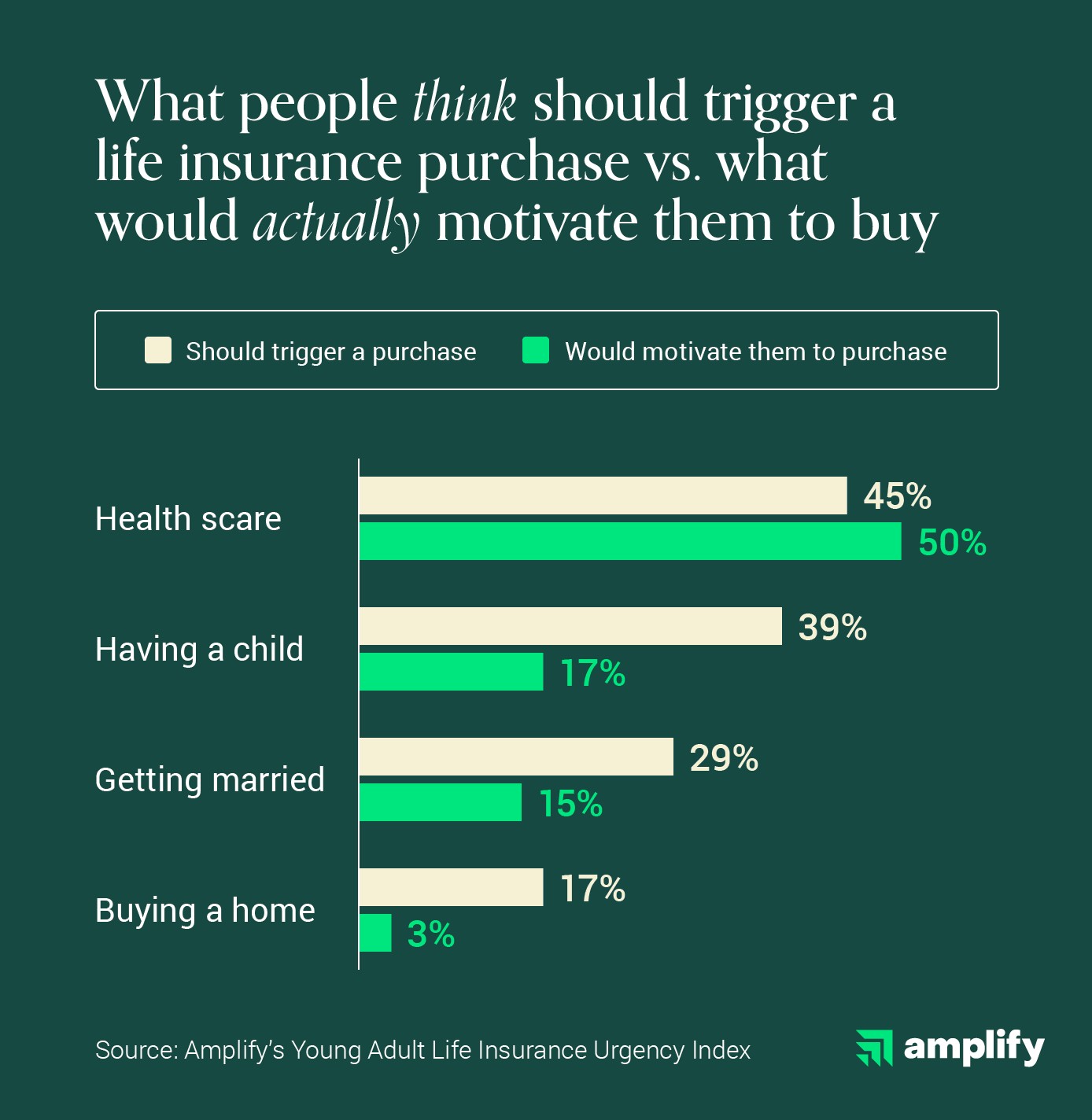
And the conventional wisdom is clearly well-established. When we asked respondents which life events they believe traditionally signal it's time to get life insurance, having a child topped the list (39%), followed by getting married (29%) and buying a home (17%).
But when the question shifted from what should prompt coverage to what would actually motivate them to buy in the next 12 months, those milestones largely fell away.
The data is consistent that anticipating a planned milestone doesn't make people buy. Having a child dropped from 39% to 17%. Getting married fell from 29% to 15%. Taking on a new mortgage collapsed to just 3%.
Health scares are a different story. A health scare jumped to 50% in the "would actually motivate" column — the only factor that increased. It's the sole trigger that closes the gap between intention and action.
This is what keeps the waiting-to-purchase cycle going. If known, approaching milestones can't generate enough urgency to move people, only a scare reliably can. Which means most adults in this survey are in a holding pattern, waiting for a moment that may not arrive on a schedule they'd choose.
Most young adults think life insurance costs far more than it does
Cost is the most-cited barrier to obtaining coverage (17%). But for most of them, that belief is built on a significant overestimate.
56% guessed that a $500,000 policy for a healthy 30-year-old costs more than $40 per month. Nearly 1 in 5 guessed over $100. Only 24% correctly approximated the actual market rate, which typically runs closer to $20–25 per month for a healthy 30-year-old.
The actual cost varies based on a handful of variables, but for someone that age in good health, most of the factors that affect life insurance premiums work in their favor. For many, getting clear on why life insurance works as a financial planning tool is what finally makes the cost feel worth it.
The overestimate makes more sense when you consider who we surveyed. 68% report household incomes under $50,000, and 31% believe premiums would be unaffordable. With no clear entry point into the research process, most of these guesses are exactly that. And they skew high.
When the most common barrier is cost and most people are overestimating it by double, the real obstacle isn't the market. Lack of information is doing more to keep people uninsured than actual pricing is.
Correcting that perception removes one of the biggest reasons to keep waiting. And for the 42% who said they'd prefer a digital path to buying life insurance, an affordable and accessible online experience could address both problems at once — making coverage feel reachable before a scare makes it feel necessary.
Parents of young children feel the urgency and still haven't acted
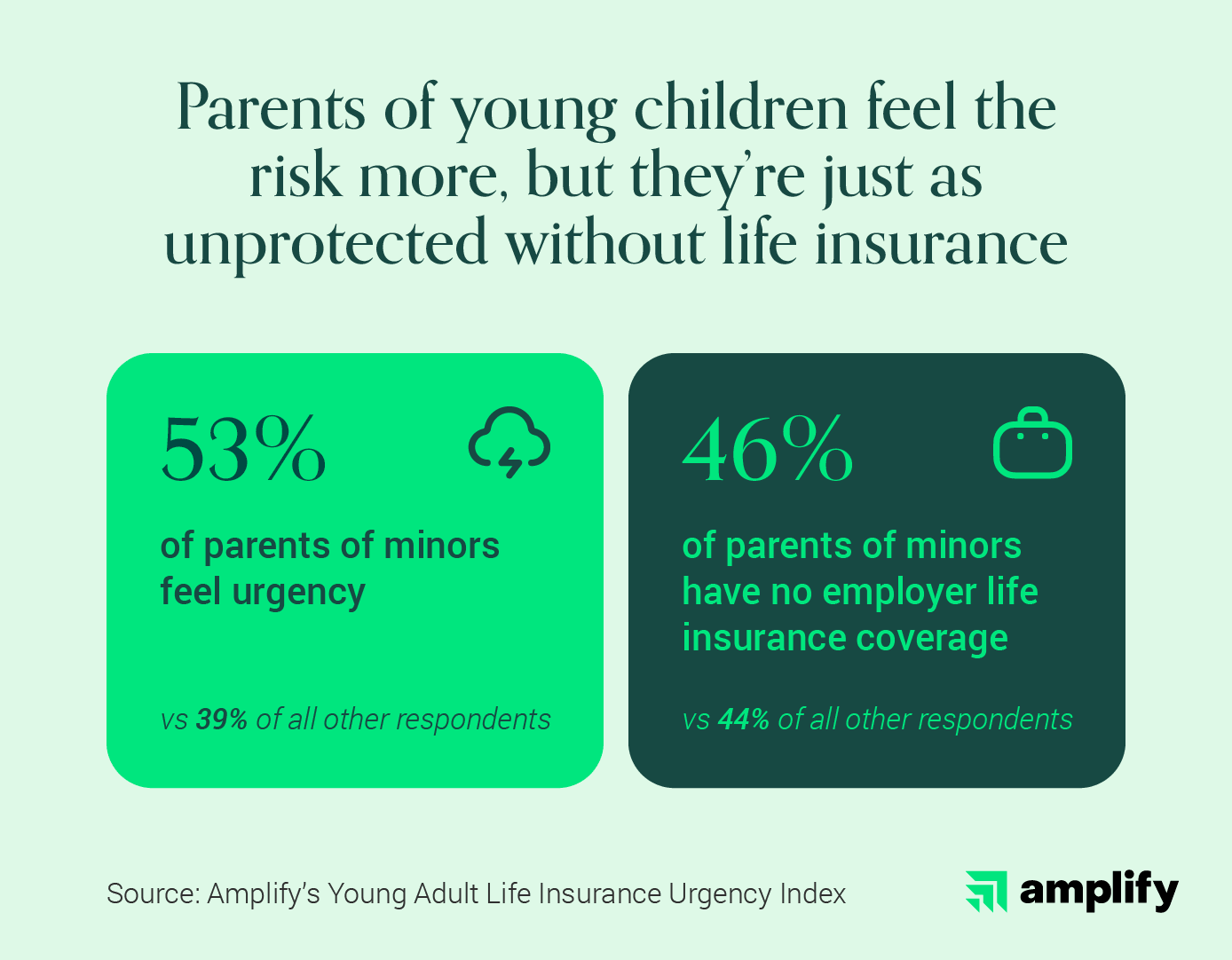
If any group should feel motivated to get covered, it's parents of young children. The stakes are concrete, and the cost of waiting is obvious. And the data confirms they feel it: 53% of parents of children under 18 said they feel they should already have life insurance or will need it sooner than they thought, compared to 39% of all other respondents.
Parents of minors are also more likely to say a personal health scare would push them to act in the next 12 months (32% vs. 26% among all other respondents).
But that heightened awareness hasn't translated into meaningfully different behavior. 46% of parents of minors either have no employer life insurance coverage, a slightly higher rate as all other respondents. The greater urgency still produces the same outcome.
The barriers keeping young parents who want to protect their children from following through — cost uncertainty, confusion about where to start, competing financial priorities — seem to affect younger adults broadly, regardless of how many dependents are in the picture.
There's a better time to act than after a scare
Most adults under 45 aren't opposed to life insurance. They're waiting for something to scare them into it.
The adults most likely to act are those who already feel ready but haven't found the right product or information to follow through. And there's one more layer to this: Most of them aren't aware of the living benefits some life insurance policies can offer alongside the core death benefit. Only 6% of respondents said they see life insurance as a tool with features they could access during their lifetime, subject to policy terms and conditions.
Certain permanent life insurance policies, such as indexed universal life (IUL), are primarily designed to provide a death benefit and may also build cash value over time. Subject to policy terms, that cash value may be accessed through loans or withdrawals for goals such as a home purchase or a child's education, though loans and withdrawals accrue interest, reduce the death benefit and cash value, and may have tax consequences. Cash value growth is not guaranteed, is subject to an annual cap and to policy fees and charges, and depends on index performance and other policy terms. For younger applicants in good health, premiums are generally lower at issue, and a longer policy duration allows more time for any cash value to accumulate.
Many people find it helpful to learn about life insurance before a personal event prompts the decision. Amplify is built for people who want to understand their options clearly, affordably, and without the jargon that's kept so many from starting.
Methodology
The survey was conducted by Centiment for Amplify. The survey was fielded from April 15–19, 2026. The results are based on 1,002 completed surveys. In order to qualify, respondents were screened to be residents of the United States and between the ages of 18 and 45. Data is unweighted, and the margin of error is approximately +/-3% for the overall sample with a 95% confidence level.